 |
| © Francois Hough 2013 |
26 October 2016
Leopard in the tree...
Sover ek weet hat Francois Hough van Chalet 14 die foto in 2013 geneem.


28 March 2011
At least one leopard is still around!
We were at Kamonande the past weekend, and the tracking conditions were just right on Saturday morning, after light drizzle during the night.
We were delighted to discover that the female that we tracked and identified during June 2010, was still around. We found her tracks on the western part of the Serengeti.
Unfortunately, we did not had enough time to check for the tracks of the young male that us active on the north and east habitat of Avontuur.
Friends, keep your eyes open, I still want a photo of the female!
We were delighted to discover that the female that we tracked and identified during June 2010, was still around. We found her tracks on the western part of the Serengeti.
Unfortunately, we did not had enough time to check for the tracks of the young male that us active on the north and east habitat of Avontuur.
Friends, keep your eyes open, I still want a photo of the female!
26 October 2010
First photos of one of the Kamonande Leopards
Great Great news!!!
We just received the first images of one of the leopards residing on the Kamonande Nature Reserve.
Louw and Sarah Hartzenberg from Chalet 42, photographed this young male late afternoon, around 18:00 on 25 October near the Telkom microwave tower.
Thanks to Otto Botha and Realta Lourens who sent us the photos.
Here's the beautiful young lad.


We just received the first images of one of the leopards residing on the Kamonande Nature Reserve.
Louw and Sarah Hartzenberg from Chalet 42, photographed this young male late afternoon, around 18:00 on 25 October near the Telkom microwave tower.
Thanks to Otto Botha and Realta Lourens who sent us the photos.
Here's the beautiful young lad.


14 August 2010
Wednesday 23 June 2010
It is Wednesday morning, after we did a night drive late Tuesday evening.
During the night drive we made various predator and antelope distress calls. We aware amazed at Anton's ability to simulate black baked jackal calls and leopard calls.
The black backed jackals responded over various distances to the calls and we could hear them moving closer to the point of call, every time thy responded.
Unfortunately we did not hear any response on the leopard calls, but we did not really expected any response, because it is mostly male leopards that occasionally call to announce their presence in the territory, letting females know they are there and to tell other males to stay out of their territory and their way.
Now let us check who visited the camera traps since yesterday and who roamed the roads and bush trails overnight...
First camera trap had a very nice find...
Can you tell what animal was photographed to the left of the bush? Look careful, it is only its back-side?
 |
| Answer: it is a honey badger trotting down the road. |
 |
| A warthog using the road... |
25 July 2010
Tuesday 22 June 2010
New day and new challenges, but first, we had to do our rounds...
... checking the roads for fresh tracks, visiting the camera traps to see who was around...
... checking the roads for fresh tracks, visiting the camera traps to see who was around...
 |
| On our way looking for fresh tracks.... |
Let's first see what the camera traps recorded?
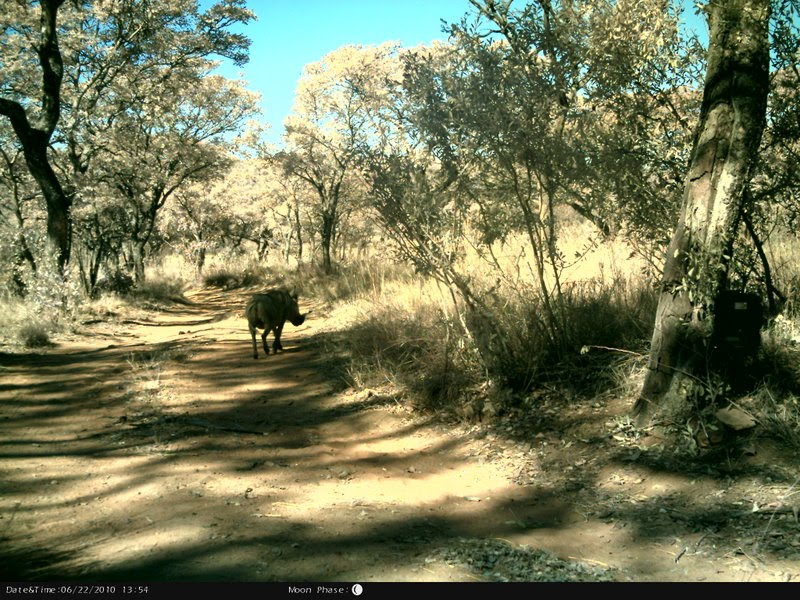 |
| Warthog taking the easy route again... |
 |
| Blue Wilde beast doing their inspection... It is amazing to see how alert they are by immediately recognising a foreign object in their habitat. |
21 July 2010
Monday 21 June 2010
 |
| Checking the photos taken by the camera traps on a digital camera... |
After a good night's rest, all were excited to see what the camera traps photographed during the night and which of the predators roamed where during the night.
Off we went, early the morning before other vehicles could drive the roads and wipe the night's tracks...
 |
| Nice shot of the young Mr. BA Boon.... |
 |
| The warthog family moving along... |
14 July 2010
Pilot Study: Day 2 - Sunday 20 June 2010 (rest of the day)
I have been away for a bit more than a week and that is the reason for the silence on the blog. But, I did not forget about the rest of the blog or where we left the study, so here we continue with the pilot study on Kamonande.
The rest of the Sunday was mainly spend walking and driving on nearly all the roads and various game foot paths where we expected to find predator tracks.

Busy looking for predator tracks... →
Tracks are usually the first indications of the predators are actually in the habitat and this is what we found during the day:
• Various red (black backed) jackal tracks in 4 different location on the reserve.
• Caracal tracks – a female with a cub.
• Civet tracks at three different locations.
• Genet tracks at two different locations.
• Brown Hyena tracks at two different locations.
The rest of the Sunday was mainly spend walking and driving on nearly all the roads and various game foot paths where we expected to find predator tracks.

Busy looking for predator tracks... →
Tracks are usually the first indications of the predators are actually in the habitat and this is what we found during the day:
• Various red (black backed) jackal tracks in 4 different location on the reserve.
• Caracal tracks – a female with a cub.
• Civet tracks at three different locations.
• Genet tracks at two different locations.
• Brown Hyena tracks at two different locations.
We recorded the exact GPS locations where we came across these tracks.
30 June 2010
Pilot Study: Day 2 - Sunday 20 June 2010
It was the morning after we set the camera traps and every-one was very excited to see what was photographed last night.
So without any avail, here are some of the photos that were captured last night...
These are the photos we found on Camera A

Jip, that was just a scrub hare...
Then.....
 Oh, this is much better, a Brown Hyena peeking around the scrub...
 Look at the 'bright headlights' ☺
.... and check out the left ear!

Here is another shot of the same one, just a bit closer but still very cautious and suspicious...
Camera B, C, D and E had nothing so let's check Camera F:

... wonder whether he was speeding?
Camera Trap G....

Well, well who do we have here?
Jip, it is the same visitor, the Brown Hyena that was photographed on camera A...
How did we know that?
Check that left ear? Looks a bit 'floppy', doesn't it?
Yea, we'll just name her Floppy Ear. ...and that is how she got her name!

She doesn't like these strange things, so off she sprints....☻
(these are photos from a camera with an infrared flash)
Camera H also had no photos...
At least we are able to to identify the Brown Hyena, by matching the recognisable floppy ear with an equally easy identifiable track of which we also made an imprint.
The rest of the day we walked the roads and bush trails looking for predator tracks and recording what we discovered.
This was it for today folks, read the next blog tomorrow!
29 June 2010
Pilot Study: Day 1 - Saturday 19 June 2010 (the afternoon)
... we continue with Saturday 19 June, the afternoon.
We scouted the reserve until about 14h30 and by that time we identified the most appropriate locations where the camera traps have to be set.

The camera traps are devices that consist mainly of:
a) a digital camera,
b) a flash (incandescent/infrared), c) a movement detector
d) battery pack
e) a memory card slot with a SD
f) in a compact box cover. 
There a various makes and models, but all basically consist of these components.
← One the camera traps mounted on a trap pole, after it was setup.

Andrew, Victoria and Sarah, busy setting a camera trap next to a road. →
The camera traps can be set at any location, but it is important to consider daytime traffic and human activities that will and can occur in the vicinity of traps.
28 June 2010
Pilot Study: Day 1 - Saturday 19 June 2010 - (the Morning)
Friday evening after we all arrived at the chalet, we had dinner and then we discussed the strategy for the next day, which was Saturday 19 June.
The research team from Ingwe Leopard project brought all their equipment with them which included 9 camera traps, GPS devices, track printing materials etc.
The first thing that we planned to do early Saturday morning, was to be out in the veld as soon as there is enough sun light to recognise tracks and to focus on areas where leopards and other predators are the most likely to occur. While scouting the habitat, we also had to identify the locations where the camera traps could be deployed during the Saturday afternoon.
Early Saturday morning the team was up and ready, and by 06h00 we were out in the veld. That early in winter, the bushveld is still quite chilly, but every-one was very excited so the cold didn't really mattered.
Within 2 km we spotted the first predator tracks, red jackal or as they are locally known, black backed jackal. This was great news, but about 1km further down the road we spotted nice fresh tracks and it looked like the ones we came to find, leopard tracks! Bingo! to find leopard tracks withing the first half an hour of the inception of such a study was really exiting. We couldn't believe our luck because no-one really expected to find fresh signs of leopard that soon.
 Now the tracks had to be recorded.
- First we took photos of the tracks.
- Then we measured the tracks.
- We also recorded the GPS data of the location where we found the tracks.
- If it is very good quality tracks, we may well decided to make track prints.

Andrew and Elandí busy measuring and photographing the tracks →
These were excellent tracks and it was decided to lift the tracks by making gypsum imprints.
These imprints are required to build a profile of the animal to ensure that we can accurately compare other tracks that we may find with this track and determine if it was the same animal's or a different individuals tracks.

← the actual leopard tracks that we found.
It takes a while to lift the tracks so we spend the next hour at this location.
27 June 2010
Pilot Study took place from 19 to 25 June 2010
The first field work session called the Pilot Study took place from the 19th to the 25the of June 2010 and a team of 9 people were involved in this pilot study.
1. Objective of Pilot Study
The main objectives of the pilot study were:

(left to right):
2.4. Enter collected data into data base
2.5. Design and produce preliminary report for reserve use
3. The Results
The following outcomes are expected.
3.1 A data base with data collected in a scientific form for creating a scientific report of carnivora presence/absence.
3.3 A preliminary pilot report based on scientific data gathered
3.4. A report for the use of data gathered for the reserve owners in a defined format
As can be imagined, a lot of information was gathered during this period and a lot was discovered. Therefore, this blog will be updated with one days information, photos, observations and remarks at a time. There will be a blog post for every day that the pilot project covered.
Keep your eye on this blog to read what we discovered and found.
1. Objective of Pilot Study
The main objectives of the pilot study were:
- To determine whether leopards do occur in the Kamonande Nature Reserve
- To determine the number of individual leopards if any are found.
- To determine what other carnivores/predators are resident or occur on the reserve.

(left to right):
Sarah White, Ben van den Berg, Elandí van den Berg, Elene van den Berg, Bernice van den Berg, Ester van Schalkwyk, Victoria Zedi, Anton van Logerenberg, Andrew Swartz.
The team stayed with van den Berg's at Chalet 17, and the pilot study covered the complete reserve.
2. The Strategy
2.1 Lay out transects through area (ground truth information gathered)- Two transects based on habitat preference along either roads or game-paths, according to camera trapping protocol
- GPS points
- Pictures of habitat structure at each camera site
- Keep camera traps at same point for total span of time
- Lay out road transects that would take approximately 2 hours to walk and gather data. (working in teams)
- Walk each route at same time each day
- Gather data regarding tracks, scat, sightings etc. with GPS data to indicate locations.
2.4. Enter collected data into data base
2.5. Design and produce preliminary report for reserve use
3. The Results
The following outcomes are expected.
3.1 A data base with data collected in a scientific form for creating a scientific report of carnivora presence/absence.
- Of GPS’d camera trap pictures with ID of individual leopard (male/female etc.)
- Of GPS’d track data
3.3 A preliminary pilot report based on scientific data gathered
3.4. A report for the use of data gathered for the reserve owners in a defined format
As can be imagined, a lot of information was gathered during this period and a lot was discovered. Therefore, this blog will be updated with one days information, photos, observations and remarks at a time. There will be a blog post for every day that the pilot project covered.
Keep your eye on this blog to read what we discovered and found.
28 April 2010
Leopard kill discovered!
Here is some very exciting news, even before the Kamonande Leopard Project research team arrive at Kamonande, the presence of leopards were witnessed.
Peter Odell and his wife Cheryl were on the Reserve the past weekend and they discovered the carcass of a young zebra, and they determined that it was a leopard kill.

Here is the story in Peter's own words:
Yesterday morning (27th) while cycling at about 9:30, up towards the Serengeti in the mist I heard distress yelping which I recognised as a zebra cry.
I continued cycling and returned home for breakfast. After breakfast Cheryl & I went out in our Terracan for a drive. On the circular drive past No 23 entrance I spotted a bird of prey circling. I said to Cheryl "perhaps there has been a kill because I heard the Zebra cries earlier.
We travelled on the road to the West (before the lapa) and after crossing the stone bed, came across signs of a scuffle and drag marks on the road. Cheryl looked out her window and saw blood on the ground. I got out of the vehicle and walked around to investigate. We saw the strange imprint on giraffe spoor on top of the scene, but there was definitly a few leopard prints. On returning to my side of the vehicle I then saw the young zebra lying dead on some rocks nearby. It had been dragged about 10m and some of its hind quarter was eaten.
I fetched my camera to record the scene. I were standing some 4m from the dead zebra we heard a faint grunt and rustle of grass coming from behind the scene. We returned to the car. I estimate that we discovered the scene at 10:45. We then drove past, turned round and observed the scene from a distance until 12:15 but no animals returned or came by.
Peter, thank you very much for this information. I will pass it on to the research team and I am sure they will also be very excited about this news.
If any of you come across signs of leopards or any other predators, on or near Kamonande, please send me your contributions and we will make it part of the research data for this project. Photos of the animals and/or their tracks are always an advantage, if you are so lucky to get any.
This is exciting stuff and I am really looking forward to the results of this project.
All the best until I post again!
05 April 2010
Project Inception
This is inception of the Kamonande Leopard Project.
The complete project is documented in the Project Charter that can be accessed here.
Why did we name it the 'Kamonande Leopard Project'?
Every-one that visit Kamonande and spot any predator during the next year, is asked to do the following:
Please invite your children and friends to follow the research project and learn from the experts. This is golden opportunity for you and them to exposed to the science side of nature. Who knows, it might just inspire some of the younger generation to pursue a career in the natural science.
The complete project is documented in the Project Charter that can be accessed here.
Why did we name it the 'Kamonande Leopard Project'?
 Leopards are the only member of the Big 5 that still naturally occur outside national parks and dedicated game reserves.
 - Leopards are at the top of the food chain and they are highly respected and admired by the majority of people.
- Ingwe, means leopard, and the Ingwe Leopard Project is the sponsor of the Kamonande project. They also provides the resources and the manpower to conduct the research.
- From time to time there are leopards at Kamonande, but only a few people were lucky to spot them and many others noticed leopard tracks in the past at various locations.

Every-one that visit Kamonande and spot any predator during the next year, is asked to do the following:
- Identify the predator, and if possible the gender of the animal,
- If record the location where it was spotted on a GPS or look for natural landmarks on order for us to accurately identify the location,
- If possible, please photograph the animal, as many photos as possible from as many angles as possible, without stressing the animal or getting yourself into danger, obviously.
- Look for other members of the species, mates, cubs, etc.
- The date and time of sighting is also important for the research data to be accurate.
Please invite your children and friends to follow the research project and learn from the experts. This is golden opportunity for you and them to exposed to the science side of nature. Who knows, it might just inspire some of the younger generation to pursue a career in the natural science.
Subscribe to:
Posts (Atom)